TAPOUT.
A lead-working tool I built for asset-recovery investigators who needed a way to work an obscene amount of raw state unclaimed-property data. It rolls California's public unclaimed-property records up by claimant, ranks them by money on the table, and gives each lead a status, a full record breakdown, and a path to a filed claim. It runs in production behind private access, for investigators only.
What it does
The dataset is California unclaimed property, public state records from $500 up. Raw, that is millions of individual line items. Tapout turns it into a queue an investigator can actually work: search a name, sort by total, and open the lead.
Rolls millions of records up by claimant
Every underlying state line item is grouped under the owner it belongs to. Each rollup card carries the total owed, how many records make it up, and the largest single record, so the biggest opportunities surface first.
Gives every lead a status
An investigator moves a claimant through a plain workflow as they work it: unchecked, contacted, verifying, submitted. A dedicated action marks a lead submitted once its claim is filed, so a queue of millions stays legible.
Opens the full record behind the number
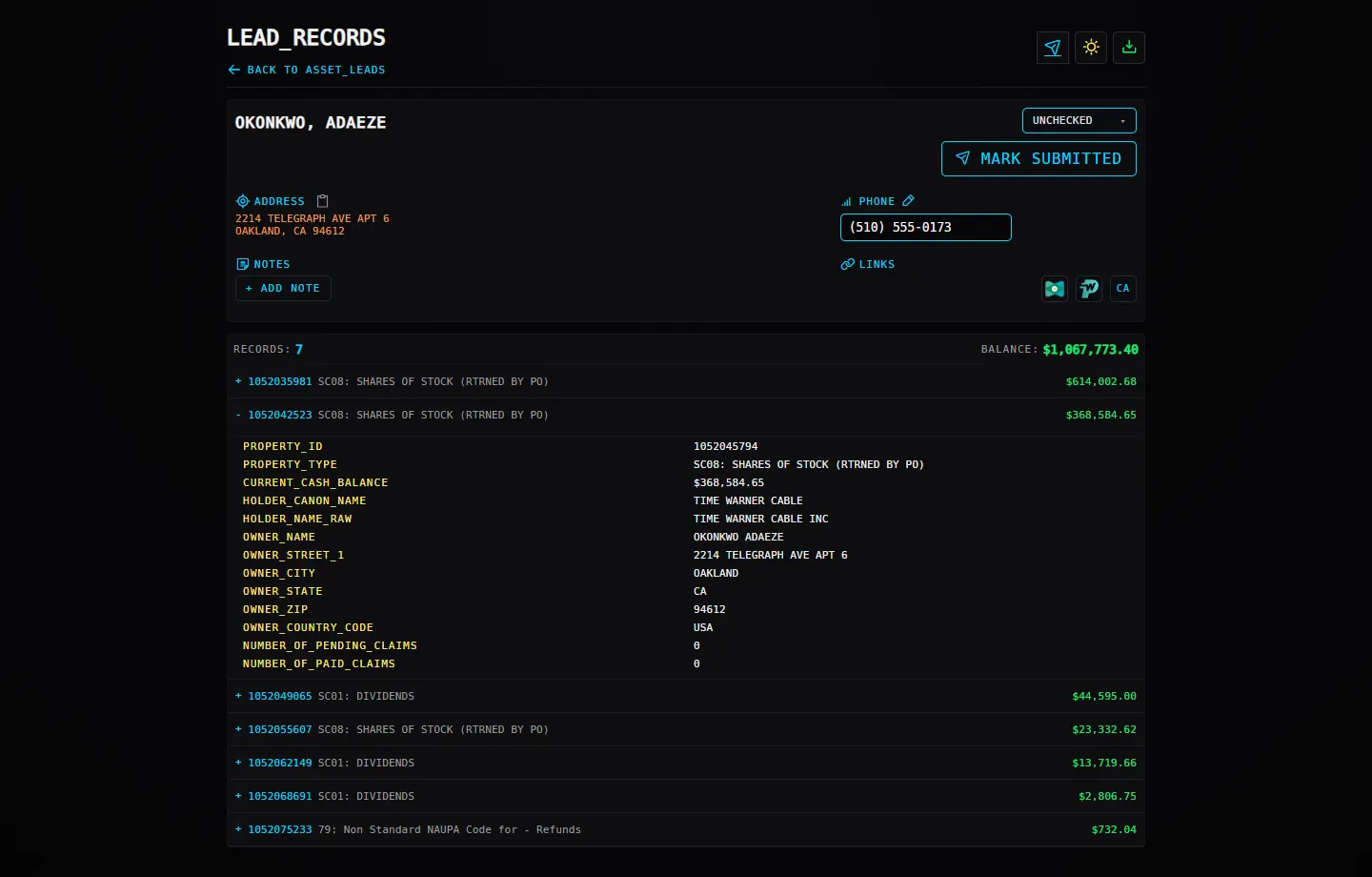
Each claimant drills down to every state record underneath: property id and type, current cash balance, holder name, the owner address block, and the pending and paid claim counts, expanded to the raw schema.
Holds the working notes
Editable notes and a phone number live on each lead, next to skip-trace link shortcuts that jump straight out to the lookups an investigator runs by hand. The context of a lead stays with the lead.
Exports what it filters
The visible working set exports to CSV for outreach and record-keeping outside the tool. Light and dark are both first-class, because this is a screen someone stares at all day.
Stays private by access control
The whole tool sits behind an authenticated access wall. Only the investigators it was built for get in, which is the right posture for a surface that works real people's financial records.
The tool
The interface is a pure-black neon terminal, built to be lived in. Below are two views: the leads board an investigator works down, and the drill-down behind a single claimant.
Every name, address, phone number, and property id shown in these screenshots is fabricated. The tool and the dataset are real.

The compliance system behind it
Finding a lead is half the job. Turning it into a claim California will honor, and a letter that reaches a real person, is the other half. That side is deliberately deterministic: no model decides anything a regulator could disagree with.
Rules, encoded
The California State Controller's claim rules are encoded deterministically into the packet engine: the right evidence for the claimant type, the right thresholds, the right disclosures, assembled the same way every time.
Bounces became gates
The first live mailing came back with 7 bounces. Each failure mode became a hard deliverability gate: deceased checks, address verification that drops vacant and undeliverable addresses before anything prints.
Proven by replay
The gates were proven the only honest way: replay the first batch through them. All 7 real-world bounces are caught before printing. A second batch, 100 letters, is rendered behind those gates.
Private by architecture
Personally identifying data never touches the public API. The public and private split is enforced at the proxy layer, not left to application-code discipline, so the outward surface stays clean by construction.
The point
Tapout takes a pile of public data too large to work by hand and makes it operable: rolled up, ranked, tracked, and drilled down, with a compliance layer that keeps the outreach legal and the identifying data private. That is the shape of the work I do: find a process buried under scale and build the system that runs it.