ALLMIND.
The control center I built to run my development operation with AI. Claude agents do the work. Monitors watch everything. I get a briefing every morning and a push notification when something breaks. It runs 24/7 on my own hardware, and I operate it from any device I'm holding.
What it actually does
Every card below is a real, running subsystem. The pattern is always the same: find a repetitive process, build an agentic workflow that removes it, keep that workflow running reliably.
Dispatches AI agents to do real work
I describe a task in plain language; ALLMIND launches a coding agent with exactly the access it needs, tracks it while it runs, and reports what it did. Research, code, maintenance, operations.
Watches everything, all the time
Background monitors track every service, agent, and system resource. When something drifts or dies, the system catches it in the moment. I don't find out two days later that something felt off.
Tells me when it matters
Failures and events that need a human route straight to my phone as push notifications. Everything else waits quietly for the morning briefing instead of interrupting me.
Briefs me every morning
A daily sweep reads overnight activity across every project and service, updates the system's memory, and delivers a human-readable brief: what happened, what needs me, what's next.
Runs whole projects on its own
For larger work, a mission pipeline takes a spec, refines it through AI debate, breaks it into tasks, executes them in isolated sandboxes, verifies the results, and queues the finished work for my sign-off.
Remembers, so I don't repeat myself
Persistent memory files and a personal retrieval engine mean agents pick up context from past sessions instead of starting cold. Decisions, constraints, and project state survive between conversations.
The live system
These are unstaged screenshots of the production dashboard, taken while it was running. The aesthetic is deliberate: if I'm going to look at a control room every day, it should feel like one.
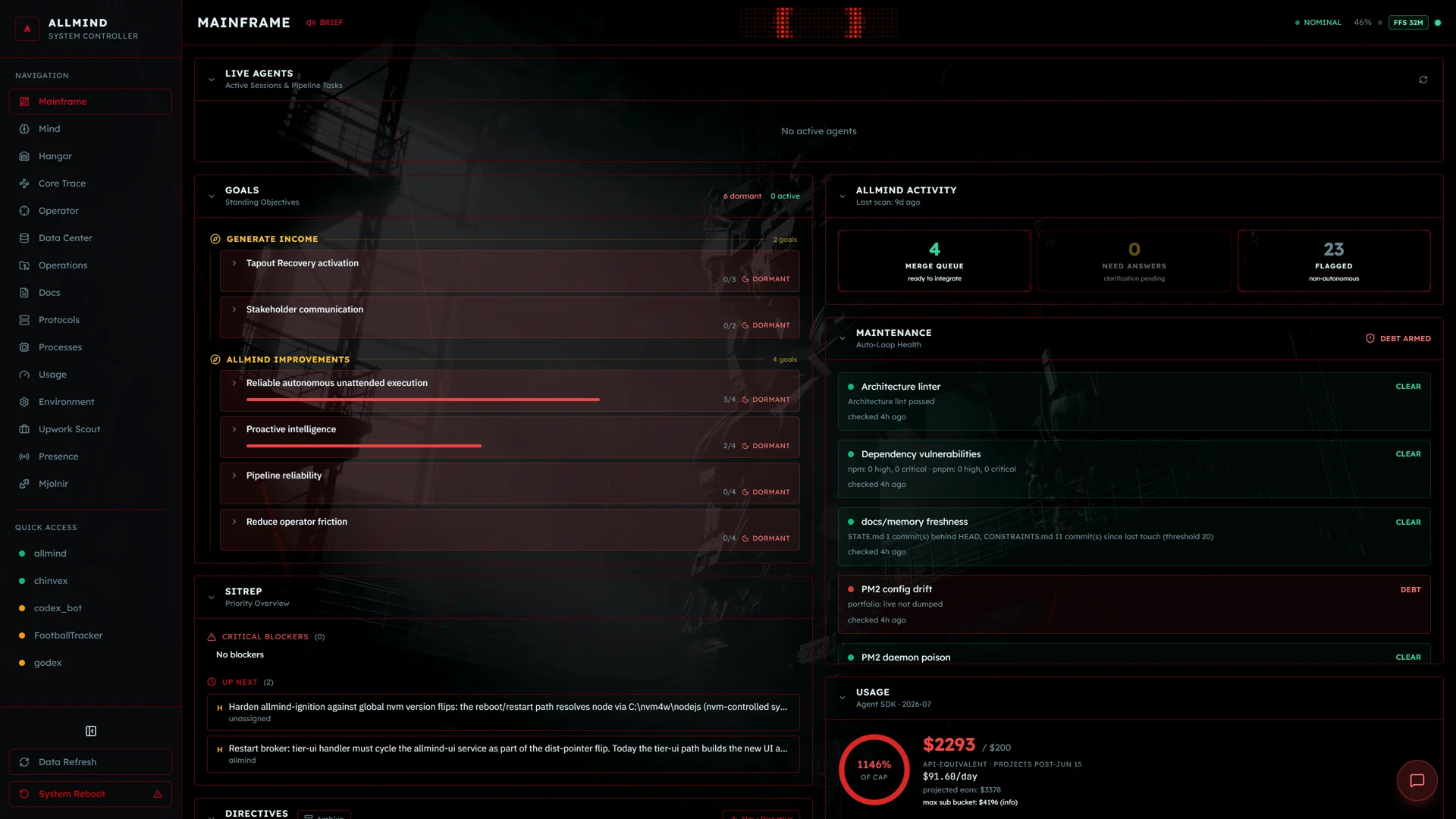
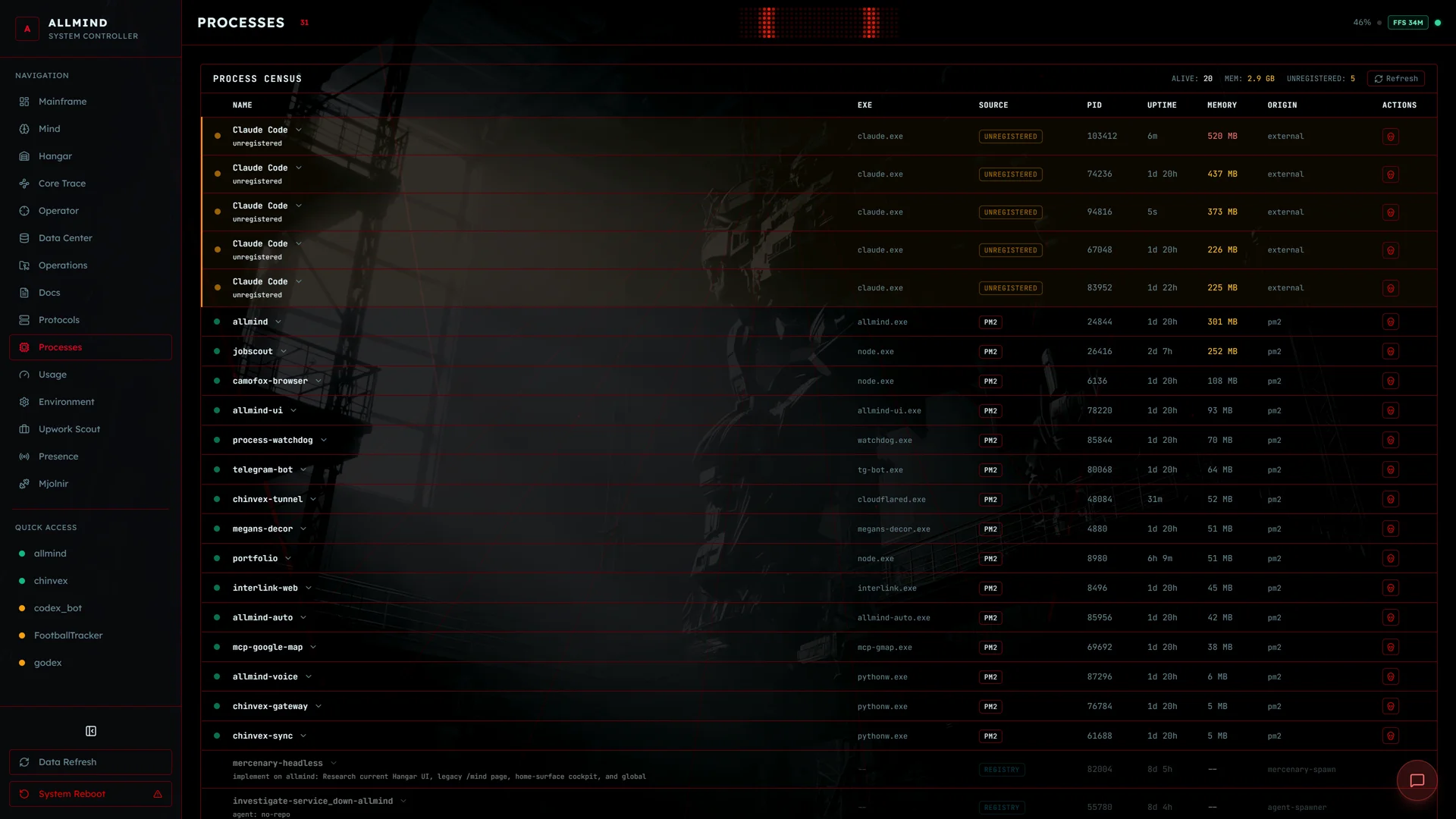
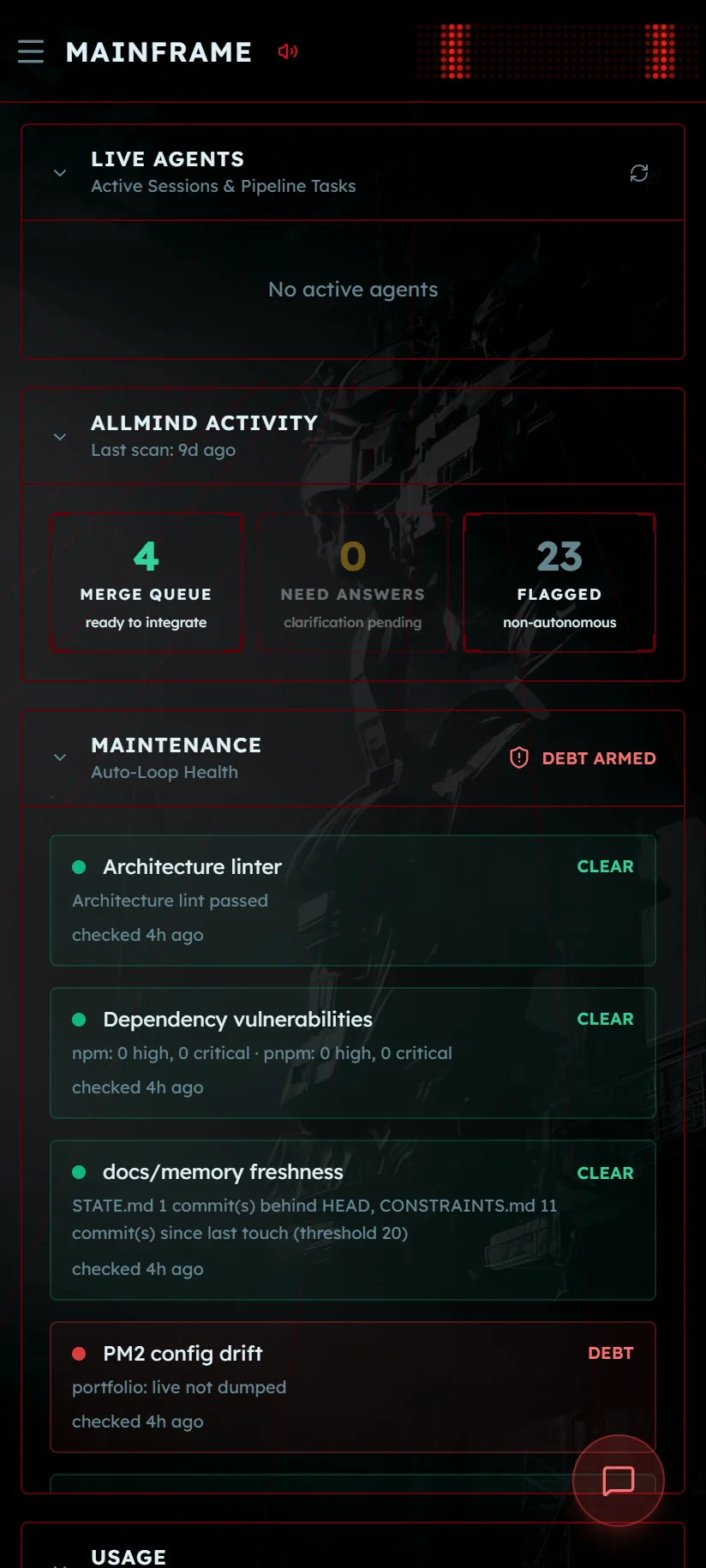
The whole system, from a phone
ALLMIND is served over a private encrypted network, so the full control surface (dispatching agents, approving finished work, checking health) works identically from my phone on the couch or a laptop across town.
Push notifications close the loop: the system doesn't need me to check it, it reaches out when something genuinely needs a human.
A normal morning
What this feels like to live with:
The system works while I sleep
Scheduled sweeps run, monitors watch the fleet, and any agents I left running finish their tasks and log what they did.
One briefing instead of twenty check-ins
The daily brief lands: what changed overnight in every project, which services stayed healthy, what's queued and waiting for my decision.
I delegate; it executes
Tasks get handed to agents in a sentence or two. Finished work stacks up in the merge queue for review. I approve outcomes; the agents handle the keystrokes.
The system reaches out first
A service crash or a failing check becomes a push notification on my phone within moments, with enough context to fix it from wherever I am. Most restarts don't even need me: the restart broker handles them automatically.
Under the hood
For the technical reader. Everything here is running in production today.
Stack
Node.js API + Next.js dashboard, a PM2-managed service fleet on Windows, and Claude (Claude Code + MCP) as the agent runtime. Private, not publicly reachable.
Agent safety
Agents run with credential-stripped environments, scoped MCP tool access, declared purpose and origin per spawn, and process-tree kill safety. No agent gets blanket access to anything.
Observability
A structured error pipeline every subsystem must emit through, enforced by a custom architecture linter at commit time. Born from a real postmortem where a silent failure cost three weeks of data.
Hardened by incident
The safety rails are earned in production: junction-safe deletes, atomic state writes, an auto-rebuilding index with corruption forensics, restart brokering that refuses dangerous windows.
Multi-channel
Web dashboard, web push, Telegram bot, and a voice channel: the same system, reachable at whatever distance the moment requires.
Memory
Structured per-project memory plus a personal retrieval engine (hybrid full-text + vector search, ~450ms warm queries over 100k+ chunks) so agents inherit context instead of rediscovering it.
The point
ALLMIND is what it looks like when one person treats their own operation as seriously as a company treats production: AI doing the repetitive work, machines doing the watching, and the human making decisions. The same pattern applies anywhere there are systems to run and processes to automate. If you have an operation that should run this way, I build these.